
Morgan Stanley Numerical Reasoning Test
Morgan Stanley Numerical Reasoning Test: Complete Guide & Free Practice Tips (2026)
Are you preparing for the Morgan Stanley numerical reasoning test? You're not alone. Thousands of candidates search for Morgan Stanley numerical reasoning test answers, practice questions, and PDF downloads every year. This comprehensive guide covers everything you need to know about the assessment, including insider tips that candidates share on Morgan Stanley online assessment Reddit threads.
What is the Morgan Stanley Numerical Reasoning Test?
The Morgan Stanley Numerical Reasoning Test is a professional psychometric assessment designed to evaluate your ability to interpret and analyze complex financial data. This isn't your typical maths test—it's specifically crafted to measure the skills you'll need in high-stakes financial roles at one of the world's leading investment banks.
Assessment Provider: Aon (formerly CEB/Gartner)
Many candidates searching for Morgan Stanley numerical reasoning test Cappfinity should note that while Cappfinity powers some assessments, the numerical reasoning component is primarily delivered through Aon's platform.
Test Overview: What to Expect
Here's the breakdown that most Morgan Stanley numerical reasoning test Reddit discussions focus on:
| Component | Details |
|---|---|
| Total Questions | 18 tasks |
| Time Limit | 6 minutes |
| Time Per Question | Approximately 20 seconds |
| Answer Format | TRUE, FALSE, or CANNOT SAY |
| Completion Rate | Most candidates do NOT finish all 18 questions |
Official Test Instructions (Direct from the Assessment)
Before you begin the actual test, you'll see these important instructions:
- The test includes 18 tasks with a 6-minute time limit
- Most people cannot complete all 18 tasks in 6 minutes—this is by design
- The test cannot be interrupted once you have started it
- You must work quickly AND accurately
- The information on the data sheets will not change during the test
- Each statement relates to only one data sheet—you need to find and refer to that specific sheet
- If not otherwise stated, all figures are related to UK-Bank
- Every task has only one correct answer
- You may change your answer by highlighting a different option
- The test will end automatically after 6 minutes
- You can stop early if you've answered all questions
- The timer starts automatically when the first task appears on screen
Critical Insight: The test is designed so that most candidates won't complete all questions. Morgan Stanley is measuring both your speed AND accuracy. Don't panic if you can't finish—focus on getting your answers right.
Question Format Explained
Every question follows a consistent multiple-choice format with three possible answers:
- TRUE – The statement is definitely supported by the data
- FALSE – The statement is definitely contradicted by the data
- CANNOT SAY – There is insufficient information to determine if the statement is true or false
Each statement has only ONE correct answer based on the provided data. This is where many candidates trip up—especially with "CANNOT SAY" options.
Real Practice Question: Worked Example
Here's an actual example of the type of question you'll face, using a UK-Bank Balance Sheet:
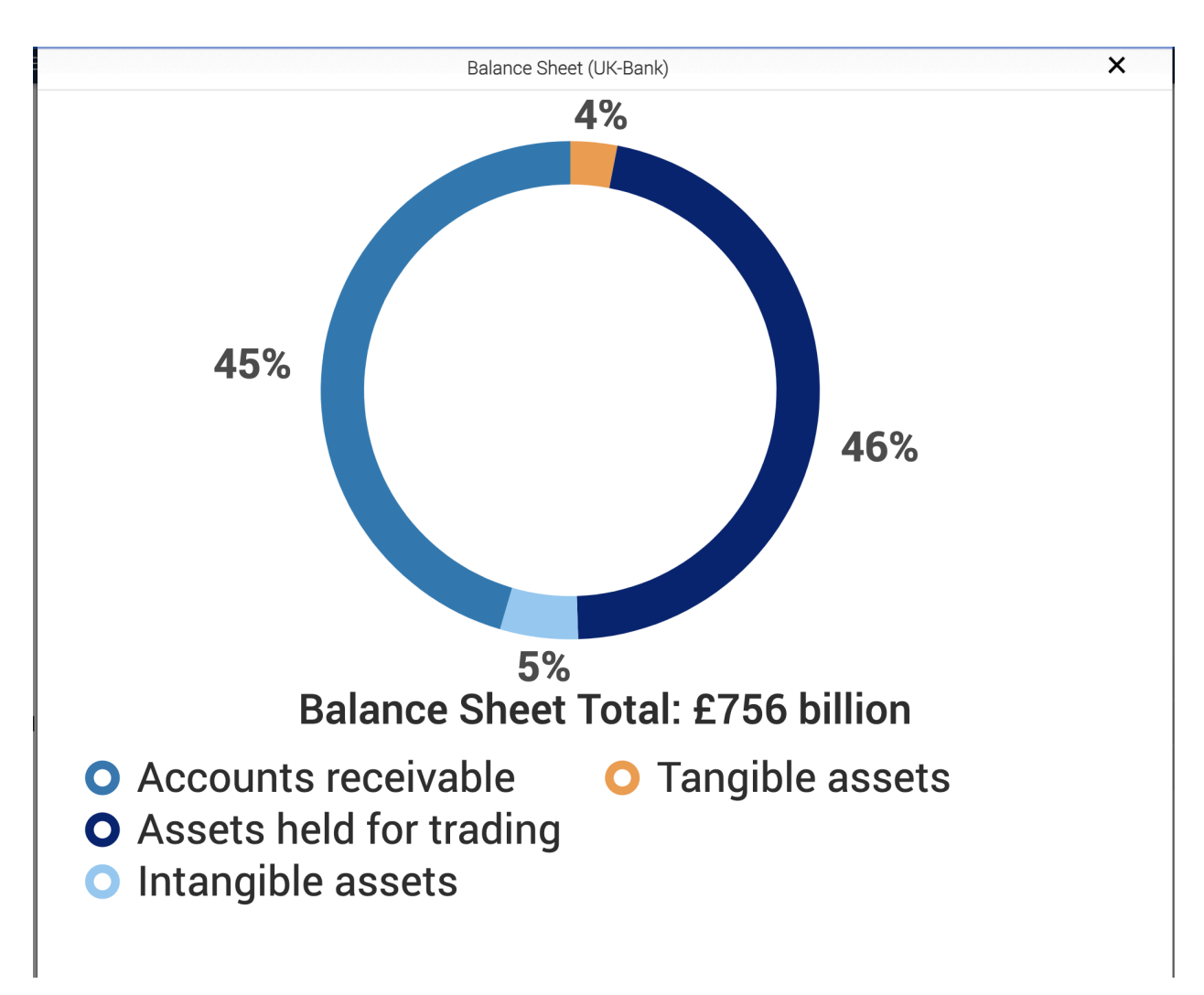
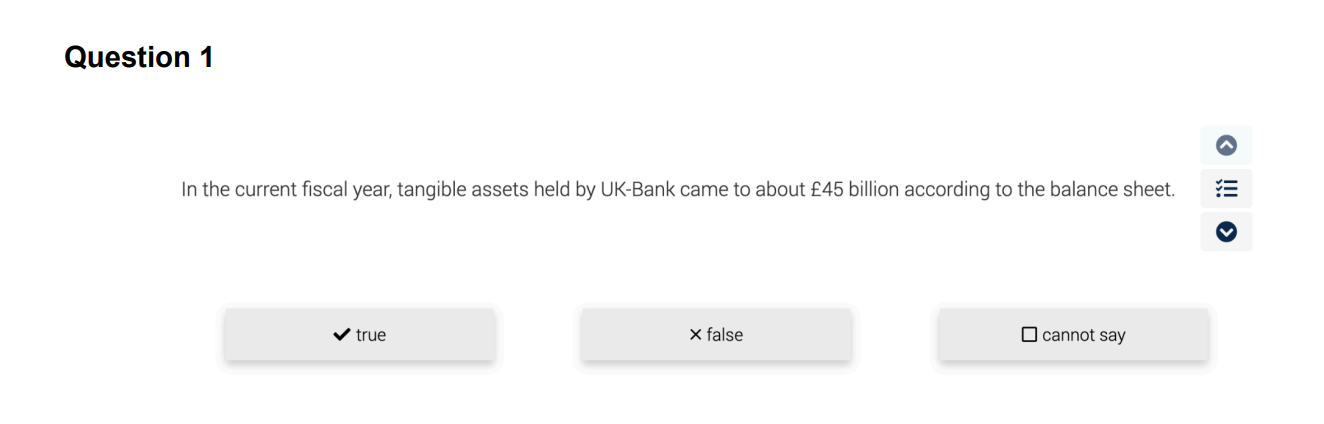
Question 1: "In the current fiscal year, tangible assets held by UK-Bank came to about £45 billion according to the balance sheet."
Answer: FALSE
Calculation: 4% of £756 billion = £756 × 0.04 = £30.24 billion (not £45 billion)
Data Provided:
- Balance Sheet Total: £756 billion
- Assets held for trading: 46%
- Accounts receivable: 45%
- Intangible assets: 5%
- Tangible assets: 4%
Question 1: "In the current fiscal year, tangible assets held by UK-Bank came to about £45 billion according to the balance sheet."
Options: TRUE | FALSE | CANNOT SAY
How to Solve This:
Step 1: Identify the relevant data
- Tangible assets = 4% of total
- Balance Sheet Total = £756 billion
Step 2: Calculate the actual value
- 4% × £756 billion = 0.04 × £756 = £30.24 billion
Step 3: Compare to the statement
- Statement claims: £45 billion
- Actual value: £30.24 billion
- These don't match
Answer: FALSE
The statement is incorrect because tangible assets equal approximately £30 billion, not £45 billion.
Key Takeaway:
Notice how the question uses "about £45 billion" to seem reasonable—but the actual figure is significantly different. Always calculate precisely before answering.
The Data Sheets: Your Key to Success
Here's something that most Morgan Stanley numerical reasoning test free resources don't tell you: the test uses a specific set of data sheets that remain constant throughout the entire assessment.
Understanding these data categories is crucial:
Types of Data You'll Encounter:
Financial Statements
- Revenue analysis (Interest income/surplus)
- Expense breakdowns (Personnel, EDP, consulting costs)
- Balance Sheets (UK-Bank focus)
Stock & Equity Data
- Common shares information
- Capital reserves
- Dividend payouts and yields
Market Trends Analysis
- Market share vs. market growth comparisons
- Client segment performance
- Competitive positioning data
Geographic Development
- Combined balance sheet totals across regions
- Regional breakdowns: Germany, America, Asia/Pacific, Europe
- Cross-regional performance comparisons
Balance Sheet Components (as seen in practice questions)
- Assets held for trading
- Accounts receivable
- Tangible assets
- Intangible assets
Free Practice Strategies That Actually Work
While many candidates search for Morgan Stanley numerical reasoning test practice free resources, the real value comes from understanding the test methodology:
Strategy 1: Master Percentage Calculations
Most questions involve calculating percentages of large totals. Practice these calculations until they're automatic:
- X% of Total = (X ÷ 100) × Total
- Always double-check decimal placement
Strategy 2: The "CANNOT SAY" Trap
Many candidates default to TRUE or FALSE when uncertain. However, "CANNOT SAY" is often the correct answer when:
- The data doesn't cover the specific time period mentioned
- The statement makes a comparison the data doesn't support
- Additional assumptions would be required
Strategy 3: Time Management Formula
With 18 questions in 6 minutes, you have roughly 20 seconds per question. Use this approach:
- First 5 seconds: Identify the relevant data sheet
- Next 10 seconds: Locate specific data points
- Final 5 seconds: Calculate, compare and answer
Strategy 4: Read Statements Carefully
Watch for words like "about," "approximately," or "roughly"—but don't let them fool you. As the practice question shows, "about £45 billion" is FALSE when the actual figure is £30 billion. The approximation still needs to be reasonably close.
What Reddit Users Say About the Morgan Stanley Assessment
Based on popular Morgan Stanley situational judgement test Reddit and Morgan Stanley online assessment Reddit discussions, here are the most common candidate experiences:
On Difficulty:
"The time pressure is real. I'm usually good at numerical reasoning but barely got through 14 questions."
On Preparation:
"Practice with actual financial data, not generic numerical reasoning tests. The questions are very finance-specific."
On the CANNOT SAY Option:
"I underestimated how often CANNOT SAY is the right answer. Don't assume you can always calculate the answer."
Common Mistakes to Avoid
Mistake 1: Searching for "Morgan Stanley Numerical Reasoning Test Answers"
There are no published answers because:
- Question pools rotate regularly
- Data sets change between test versions
- Memorising answers won't help with the actual test format
Mistake 2: Ignoring the Situational Judgement Component
Many candidates focus solely on numerical reasoning, but the Morgan Stanley situational judgement test is equally important. This assesses:
- Decision-making in workplace scenarios
- Alignment with Morgan Stanley's values
- Professional judgment under pressure
Mistake 3: Not Practicing Under Time Pressure
Completing practice questions without timing yourself creates a false sense of readiness. Always simulate the 20-second-per-question pressure.
Mistake 4: Rushing Calculations
As the practice question demonstrates, a quick glance might make £45 billion seem plausible—but proper calculation reveals it's £30 billion. Take the few extra seconds to verify your maths.
How to Access Practice Materials
While searching for Morgan Stanley numerical reasoning test PDF download 2026, be cautious of unofficial sources. Here are legitimate ways to prepare:
Official Resources
- Morgan Stanley's careers website often provides sample questions
- Aon's practice platforms (the official test provider)
- Graduate recruitment preparation guides from your university
Recommended Practice Approaches
- Financial newspaper analysis – Practice interpreting data from the Financial Times or Wall Street Journal
- Annual report exercises – Work through real company financial statements
- Timed practice sessions – Use any numerical reasoning test under strict time conditions
- Percentage calculation drills – Master quick mental maths for percentages of large numbers
The Complete Morgan Stanley Assessment Process
The numerical reasoning test is just one component. The full assessment typically includes:
- Online Application – CV and cover letter review
- Numerical Reasoning Test – 18 questions, 6 minutes (Aon)
- Situational Judgement Test – Workplace scenario assessment
- Video Interview – Pre-recorded responses to behavioural questions
- Assessment Centre – Group exercises and final interviews
Frequently Asked Questions
Can I retake the Morgan Stanley numerical reasoning test?
Generally, you must wait 6-12 months before reapplying if unsuccessful. Policies vary by region and role.
Is a calculator allowed?
Yes, you can use an on-screen calculator, but with only 20 seconds per question, extensive calculations aren't practical. Practice mental maths for percentage calculations.
What score do I need to pass?
Morgan Stanley doesn't publish cut-off scores. Focus on accuracy over completion rate.
How does the Aon test differ from Cappfinity?
Aon (the Morgan Stanley provider) uses TRUE/FALSE/CANNOT SAY format, while Cappfinity typically uses multiple-choice numerical answers. The skills tested are similar, but the approach differs.
What if I don't finish all 18 questions?
This is expected! The instructions explicitly state that most people cannot complete all 18 tasks. Focus on accuracy for the questions you do answer.
Final Preparation Checklist
Before your test date:
- [ ] Practice percentage calculations until automatic (e.g., 4% of £756bn = £30.24bn)
- [ ] Complete timed practice sessions (strict 6-minute blocks)
- [ ] Review balance sheet and income statement relationships
- [ ] Practice the TRUE/FALSE/CANNOT SAY format specifically
- [ ] Understand that all figures relate to UK-Bank unless stated otherwise
- [ ] Ensure stable internet connection and quiet testing environment
- [ ] Test your computer setup in advance
- [ ] Accept that you likely won't finish all 18 questions—that's normal
Conclusion
The Morgan Stanley Numerical Reasoning Test is challenging by design. It's meant to identify candidates who can quickly and accurately analyse financial data under pressure—exactly what you'll do in the role.
Rather than searching for Morgan Stanley numerical reasoning test answers or shortcuts, invest your time in genuine preparation:
- Understand the test format thoroughly
- Practice with real financial data
- Develop rapid data interpretation skills
- Master time management under pressure
- Practice percentage calculations until they're second nature
Remember: Morgan Stanley isn't just looking for candidates who can do maths quickly. They want professionals who can make accurate judgments about financial data when it matters most.
Good luck with your application!
Last updated: January 2026
Disclaimer: This guide is based on publicly available information and candidate experiences. Test formats and content may change. Always refer to official Morgan Stanley recruitment communications for the most current information.


