Mondelez Online Assessment (2026): A Complete, No-Fluff Guide
- The Mondelēz International Online Assessment for a 2026 internship and graduate roles consists of 4 stages
- The first stage is a video interview about the role and the company and how you fit into it
- The other stages are personality and behavioural tests
- The Mondelez cognitive ability test is the hardest to do, it is timed and so there is added pressure to complete
The Mondelēz International Online Assessment uses sections 2 through 4 to evaluate 11 core competencies that the company has identified as critical for success in early career professional roles.
Here is an overview and context for the answers in these sections:
Section 2 & 4: Personality and Behavioural Tests
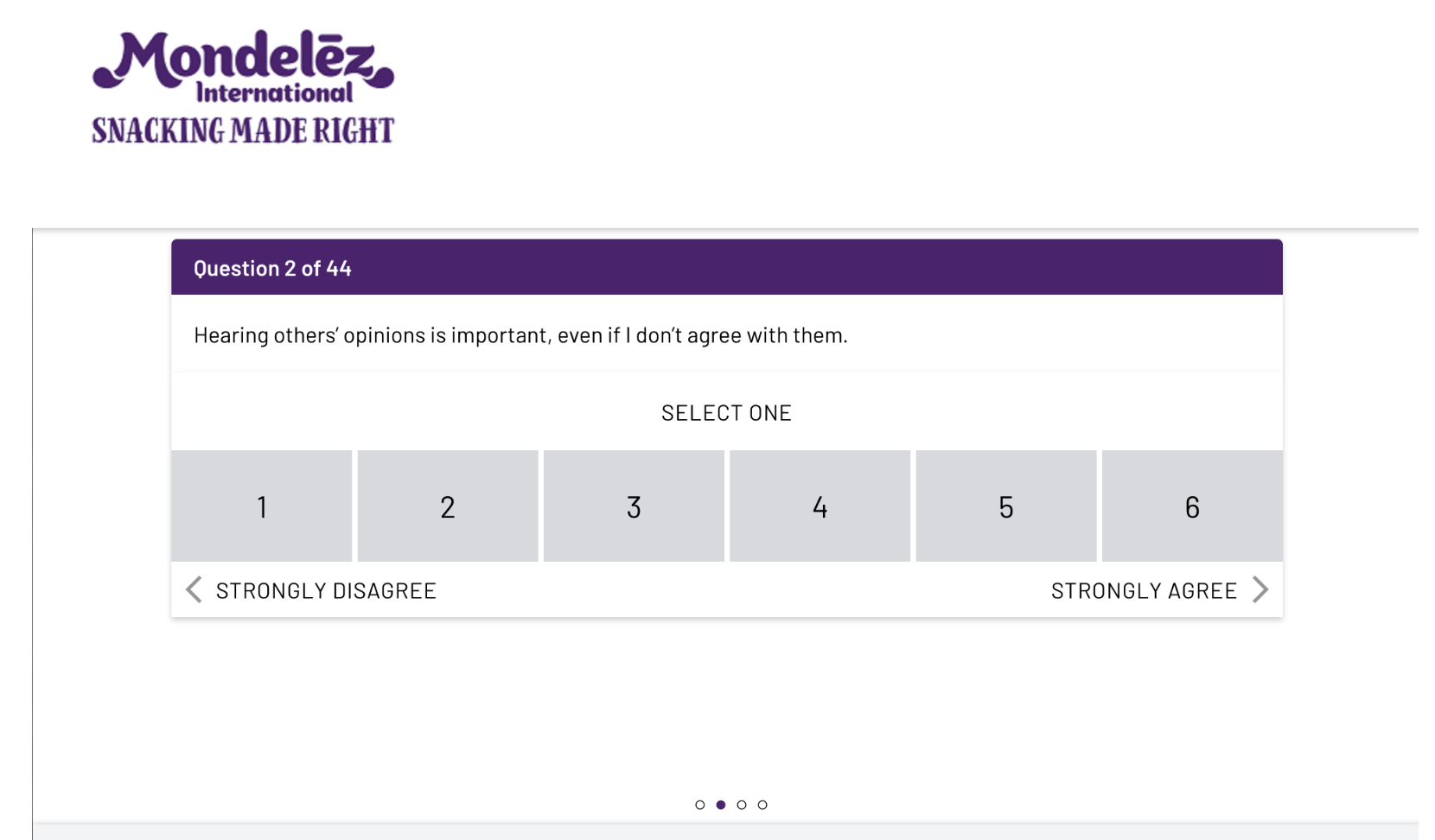
- These sections are untimed and consist of 44 questions in Section 2 and 41 questions in Section 4. You are asked to rate your agreement with various statements on a 6-point scale, from 1 (Strongly Disagree) to 6 (Strongly Agree).
What they are looking for:
Mondelēz is assessing your natural work style and behavioral tendencies. To score well, your answers should consistently reflect these themes:
- Organization and Planning: They value candidates who use task lists and plan ahead to manage priorities.
- Resilience and Stress Management: Questions about "bouncing back" or "picking yourself up" after problems test your ability to handle the high-pressure manufacturing environment.
- Growth Mindset: They prioritize those who actively seek to learn new skills and find better ways to do things.
- Collaboration: Mondelēz emphasizes teamwork, valuing those who enjoy working with others and listening to different points of view.
- Accountability: They look for individuals who take responsibility for their work and are proactive in helping others.
Section 3: Cognitive Ability (Path-Finding)
This is a game-based assessment where you must create a valid path from a starting icon to an ending icon.
- Objective: Connect the icons by rotating tiles and changing arrow directions.
- Efficiency: While not strictly timed for speed, your goal is to find a path using the least number of moves.
- Time Limit: You have approximately 4 minutes per grid, and there are 3 grids in total to solve.
 Aptitudeprep
- Below is a clear, practical guide built around the questions applicants type into Google—so you can scan to the bit you need, prep fast, and move on.
What is the Mondelez online assessment?
Mondelez International Practice question
Mondelez International Practice question + answer
Mondelez International Practice question + answer
This type of question is a classic Situational Judgment or Personality Assessment used by companies like Mondelēz. For graduate roles, they aren't just looking for your personal opinion; they are looking for cultural fit and specific competencies.
Here is a methodical breakdown of how to approach this question for a graduate application.
1. Identify the Competency
This question is testing for Open-mindedness, Collaboration, and Emotional Intelligence (EQ). In a global company, Mondelēz values employees who can work in diverse teams where conflict and differing viewpoints are inevitable.
2. Evaluate the "Corporate Ideal"
- Strongly Agree (5 or 6): Suggests you are coachable, inclusive, and recognize that diverse perspectives lead to better business outcomes (innovation).
- Strongly Disagree (1 or 2): Suggests you might be arrogant, rigid, or difficult to work with in a team setting.
3. The Methodology: The "Likert Scale" Strategy
Since this is a 6-point scale, there is no "neutral" middle ground. You must take a side.
Score Interpretation for Recruiters 1 - 2 Red Flag: High risk of being "my way or the highway." Not suitable for collaborative grad roles. 3 - 4 Hesitant: You might listen, but you don't necessarily value the input. It feels like "going through the motions." 5 - 6 Ideal: You actively value the process of debate. 6 is the strongest "Corporate Green Flag" here. 4. Recommended Answer
For a graduate role at Mondelēz, you should select 6 (Strongly Agree).
Why this is the right move:
- Growth Mindset: Graduates are expected to learn. Listening to others—especially when you disagree—is how you identify blind spots in your own logic.
- Conflict Resolution: It shows you can maintain professional respect even during disagreements.
- Mondelēz Values: Their "Snacking Made Right" mantra relies on cross-functional teamwork (Marketing, Supply Chain, Finance). You cannot succeed in these roles if you shut down dissenting voices.
Pro-Tip for Students: Consistency is key. These tests often ask the same question three different ways throughout the 44-question block. If you select "Strongly Agree" here, ensure you don't contradict yourself later if they ask, "I prefer to make decisions alone without input."
What is the assessment process for Mondelez?
The flow varies by region and role, but a common path is:
- Online application – CV, basic details, and a few eligibility questions.
- Online tests – SHL-style general ability + SJT (sometimes split into separate numerical, verbal, logical tests).
- Pre-screen interview – usually a one-way video (recorded answers) or brief phone/video call.
- Assessment centre – group exercise, case/presentation, role-play and a final competency interview (virtual or on-site).
- Offer & onboarding – documents, start date, pre-employment checks.
What is asked in the Mondelez online assessment test?
Expect multiple-choice questions within tight time limits:
- Numerical reasoning: interpret charts/tables, percent changes, ratios, rate/trend comparisons. The maths is GCSE-level; the challenge is speed + accuracy.
- Verbal reasoning: read a short passage, decide if statements are True / False / Cannot Say based on the text.
- Logical/inductive reasoning: spot patterns across grids of shapes (movement, rotation, number of sides, shading rules) and pick the next in sequence.
- SJT: choose how you’d respond to stakeholder, team and customer scenarios. Options are often all “plausible”—you’re judged on alignment to competencies and values.
Tip: SHL tests are norm-referenced—you’re compared to a cohort, not a fixed pass mark. Good pacing and consistency matter as much as raw score.
How difficult is it to get a job at Mondelez?
It’s competitive. Mondelez is a global brand with strong name recognition; early-career schemes attract thousands of applications. The bar isn’t “impossible,” but time-boxed accuracy and value alignment filter people out quickly. Candidates who practice under test-like timing and prepare competency stories tend to sail through compared with equally smart but under-prepared peers.
Does Mondelez use game-based assessments?
Game-based tasks pop up at some multinationals. For Mondelez, the core remains SHL-style ability + SJT. In a few regions/roles, you may see brief game-like cognition mini-tasks or video questions within the vendor platform. Always read your invitation email carefully—the email is your single source of truth for the exact test set you’ll face.
How many interview rounds are there at Mondelez?
Typically two substantive interviews:
- Pre-screen (short one-way video or phone/video chat)
- Final (as part of the assessment centre—competency/technical)
Some roles add a manager interview after the AC, but most graduate/Intern tracks combine the final interview with the centre exercises.
How good is the Mondelez interview?
Structured and competency-based, with a friendly but brisk pace. Expect 5–8 questions covering teamwork, problem-solving, learning agility, stakeholder management and results orientation. Use STAR+R:
- Situation
- Task
- Actions (focus here)
- Result (quantify)
- Reflection (what you learned, how you improved)
Bring evidence: data points, metrics, and clear outcomes. Tie back to Mondelez values (doing what’s right, growth mindset, brand/customer centricity).
How to pass the Mondelez online assessment (fast, practical plan)
One week out
- Warm up daily: 20–30 mins each of numerical + logical + verbal under strict time. Track your average time per question and error types.
- SJT calibration: skim job description and values page; identify 5–7 “golden behaviours” (e.g., safety-first, data-driven decisions, cross-functional collaboration, customer focus, integrity, inclusive teamwork). Rank SJT options by those behaviours.
48–72 hours out
- Drills: do two full-length mixed tests back-to-back (simulate fatigue).
- Formula sheet (mental): percent change, ratio, weighted average, currency/unit conversions.
- Pattern library: walk through common logical rules (rotation ±90°, element count progressions, alternating shading, mirroring, in/out rules).
On test day
- Numerical: scan the question stem first, then the data. If the question doesn’t require all tables/graphs, ignore them. Round sensibly; use elimination on close options.
- Verbal: the passage is the only truth. If not explicitly supported, “Cannot Say.”
- Logical: identify two rules (primary + secondary). If stuck after 30–40 seconds, guess and move.
- SJT: pick the most principled + stakeholder-aware + safety/value-aligned response; avoid extremes (reckless autonomy, passivity, or bypassing process).
What if I fail the assessment test?
Not the end. Many candidates re-apply successfully:
- Cooldowns vary by role/region (some windows are 3–12 months). Check your email/portal.
- Debrief yourself: was it timing, accuracy, or misunderstandings? Your practice analytics should show where you bled time or points.
- Targeted rebuild: do short, high-intensity sets (e.g., 10 questions in 7 minutes) for your weakest area for 5–7 days, then retake a full mock.
How do I know if I passed?
Vendors rarely show raw scores. Typical signals:
- An email inviting you to the next stage within a few days.
- A portal status change from “Assessment Pending” to “Under Review” or “Next Step Scheduled.”
- Occasionally, a percentile/“above benchmark” note—treat it as directional only.
If you hear nothing after the stated timeline in your invite, politely nudge the recruiting contact.
What is asked in a Mondelez assessment centre?
A compact, values-rich day with:
- Group exercise – discuss a brief, trade-off constraints, reach a recommendation. Show listening, facilitation, time-keeping, and evidence-based decisions.
- Presentation/case – 20–30 min prep, 10–15 min delivery + Q&A. Structure: Context → Options → Criteria → Recommendation → Risks/Next steps.
- Role-play – stakeholder conversation (supplier, internal manager, retailer). Demonstrate empathy, probing questions, and principled negotiation.
- Final interview – STAR+R competencies + motivation (“Why Mondelez/this function?”).
Bring your own questions (growth, rotation opportunities, how teams collaborate across plants/markets, how success is measured in year 1).
How to prepare for a Mondelez video interview
- Environment: quiet, eye-level camera, test mic.
- Answer bank: 8–10 STAR+R stories mapped to common themes (team conflict, tight deadline, data-driven decision, learning from failure, influencing without authority).
- Delivery: 60–90 seconds per answer segment; look at the camera, not the screen.
- Mini-close: finish answers with a result metric and a reflection tied to Mondelez values.
Quick checklist (save this)
- ☐ Read the invite carefully—your exact test list lives there
- ☐ 5 days of timed practice (mixed sets > single-topic only)
- ☐ SJT alignment list (values + behaviours)
- ☐ 10 STAR+R stories (headline + numbers)
- ☐ Assessment-centre frameworks (group, case, role-play)
- ☐ Camera/mic check + quiet space
- ☐ Two smart questions for each interviewer
Final word
You don’t need to become a psychometrics genius—you need test-specific practice, crisp frameworks, and value-aligned judgement. Do that, and you’ll comfortably clear the Mondelez online assessment and feel confident for the interviews and assessment centre.


