
National Grid Digital Assessment
Complete Guide to the Digital Assessment & HireVue Interview 2026
- If you've just received your National Grid digital assessment invitation, congratulations — you've made it past the application stage.
- Now comes the part that catches most candidates off guard: a 60-minute online assessment powered by HireVue that blends game-based assessment challenges with a video interview.
This guide breaks down everything you need to know about the National Grid online assessment 2026, including what to expect from each section, the exact types of questions asked, and how to prepare effectively.
 Aptitudeprep
 Aptitudeprep
What Is the National Grid Online Assessment?
- The National Grid online assessment is a two-part digital evaluation used to screen candidates for their Graduate Development Programme and other roles.
- It's hosted on the HireVue platform and designed to measure both your cognitive abilities and behavioural competencies.
You should plan for approximately 60 minutes to complete the assessment, which includes a video-based interview with several questions as well as a game-based component. You'll have the opportunity to practice the assessment before you begin, and while National Grid recommends completing everything in one session, you can log back in if needed.
National Grid Assessment Structure at a Glance
| Section | Format | Duration | What It Measures |
|---|---|---|---|
| Game-Based Assessments | Two interactive games ("Numerosity" and "Shapedance") | ~7 minutes | Numerical reasoning, spatial awareness, cognitive agility |
| Video Interview | Six competency-based questions recorded on camera | ~18 minutes (3 mins per question) | Behavioural competencies using the STAR method |
| Total | — | ~25–60 minutes | Overall suitability for the role |
- The actual active assessment time is around 25 minutes, but National Grid advises blocking out 60 minutes to account for setup, practice rounds, and reading instructions.
National Grid Game-Based Assessments
- Before you record any video responses, you'll complete two short cognitive games. These aren't traditional aptitude tests — they're gamified challenges that measure how you think, not just whether you get the right answer.
Numerosity (~3 Minutes)
This is a rapid-fire numerical reasoning game. You're given a target number and a set of bubbles containing numbers and mathematical operators (+, −, ×, ÷). Your job is to form the target number as quickly as possible.
How to prepare:
- The game is adaptive — correct answers lead to harder equations, so don't worry if it suddenly feels more difficult. That means you're doing well.
- Practice mental maths shortcuts. If your target is 24, look for factor pairs like 6 × 4 or 12 × 2 rather than trying to add smaller numbers together.
- Speed matters, but so does accuracy. The system tracks both.
Shapedance (~4 Minutes)
This is a spatial reasoning game. You're shown a grid of shapes (typically 3×3 or 4×4) and then a second grid. You need to determine whether the second grid is an exact match, a rotation, or a mirror image of the first.
How to prepare:
- Pick a "marker" shape in one corner of the grid (like a unique star in the top-left) and follow its position through the transformation. If the marker checks out, the rest usually will too.
- Practice visualising 90° and 180° clockwise rotations.
- These games measure cognitive flexibility and pattern recognition — traits National Grid values highly in their workforce.
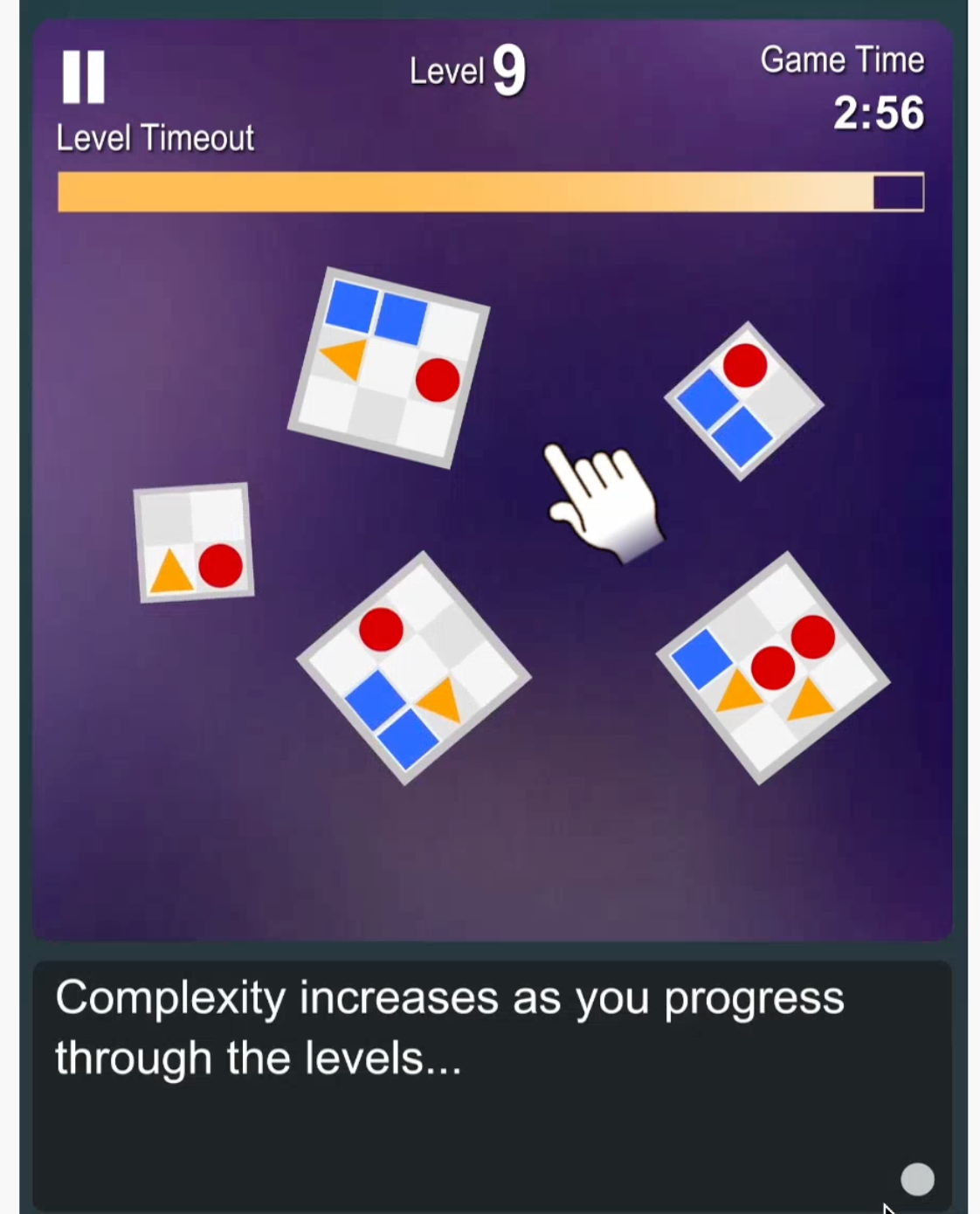
National Grid Game-Based practice question
National Grid Game-Based Answer
national grid shapedance question and answer
Looking at this Shapedance puzzle, you need to match cards that are identical (or rotations/mirrors of each other).
Let me analyse each card by mapping the shapes on their grids:
Card 1 (top-left, larger): 4×4 grid — blue squares top-left area, orange triangle middle-left, red circle middle-right
Card 2 (top-right, smaller): 2×2 grid — blue square top-left, red circle top-right — this looks like a zoomed-in section
Card 3 (bottom-left, small): 2×2 grid — orange triangle bottom-left, red circle bottom-right
Card 4 (bottom-centre, larger): 4×4 grid — red circle top-centre, blue square bottom-left, orange triangle bottom-right
Card 5 (bottom-right, larger): 4×4 grid — red circle top-right, two red circles, blue square top-left area, two orange triangles bottom-right
The Match
Card 1 (top-left) and Card 4 (bottom-centre) are rotations of each other. If you rotate Card 1 roughly 180°, the positions of the blue squares, orange triangle, and red circle align with Card 4's layout.
Similarly, Card 3 (small, bottom-left) and Card 2 (small, top-right) appear to be sections of the same pattern — both are 2×2 with the same shapes, just repositioned.
Strategy Tips for the Real Assessment
- Start with the smallest cards — fewer shapes means quicker comparison
- Pick one unique shape as your anchor (e.g. the orange triangle) and track where it sits relative to the others
- Don't overthink — the level timeout bar is draining fast. A quick confident match beats a slow perfect analysis
- Complexity increases as the message says, so the early levels are your chance to build speed before grids get larger
National Grid Video Interview Questions
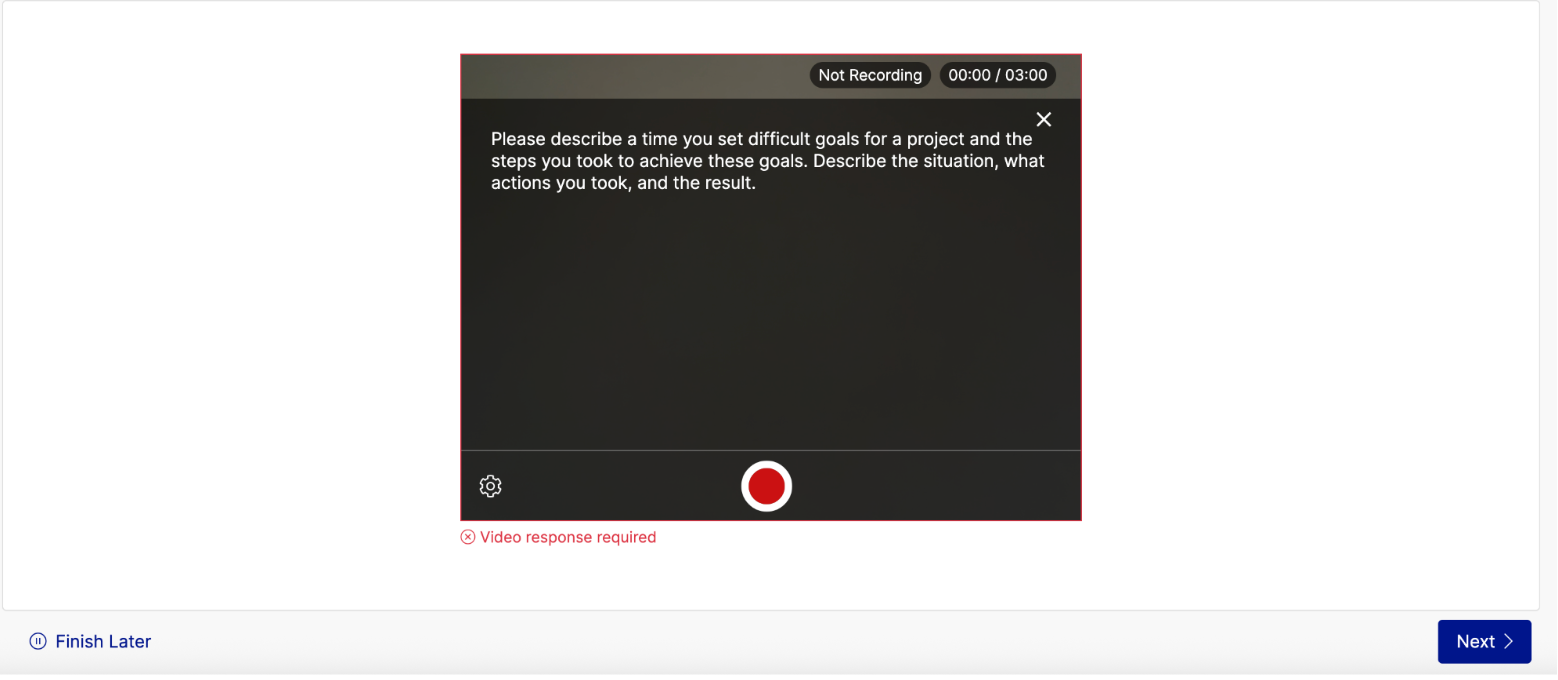
After the games, you move into the National Grid video interview. This is a one-way recorded interview: you'll see a question on screen, get a moment to prepare, and then record your answer. Each response has a 3-minute time limit, and there are typically six questions.
National Grid Video Interview Practice Question
National Grid Video Interview Practice Answer
Please describe a time you set difficult goals for a project and the steps you took to achieve these goals.
"During my final year at university, I took on a group design project where we had to design and prototype a small-scale renewable energy system — specifically a wind turbine that could generate enough power to charge a mobile phone. We had 12 weeks and a budget of just £150, which was tight for the components we needed.
I was the project lead, and early on I set two goals that my teammates thought were quite ambitious. First, I wanted us to have a working physical prototype, not just a theoretical design on paper — which is what most groups defaulted to. Second, I wanted us to present actual measured power output data, not just simulated figures from MATLAB.
The first step I took was mapping out the 12 weeks backwards from the deadline. I broke it into three phases — four weeks of research and design, four weeks of building and testing, and four weeks for refinement, data collection, and the final report. I shared this with the team so everyone knew exactly what needed to happen each week.
The biggest challenge came in the build phase. We'd sourced a small DC motor to use as a generator, but when we tested it the voltage output was far lower than our calculations predicted. Rather than panic, I went back to the fundamentals — I spent an evening reviewing the motor specifications and realised the issue was the blade RPM. Our blades were too heavy for the wind speeds we were testing at. I redesigned the blades using lighter 3D-printed PLA, and on the second round of testing the output improved significantly.
There was also a point around week eight where one of our team members fell behind on the electrical circuit design. Instead of waiting for them to catch up, I picked up part of the wiring work myself over a weekend so we wouldn't lose a full week from the schedule. It wasn't my assigned area, but I felt responsible for the overall goal.
By the end, we had a fully working prototype that generated 4.2 watts in controlled wind tunnel conditions — enough to charge a phone slowly, which is exactly what we'd set out to do. We were one of only three groups out of fifteen that had a working prototype with real test data. We scored 78 on the project, which was the highest in our cohort.
What I took away from that experience is that difficult goals become manageable when you plan backwards from the deadline, build in contingency time, and stay willing to get your hands dirty when something isn't going to plan."
Why this works:
- Relatable — university group project, no fancy work experience needed
- Engineering-specific — mentions prototyping, MATLAB, RPM, 3D printing, wind tunnel testing
- Shows leadership without a job title — took ownership, helped struggling teammates
- Quantified results — £150 budget, 4.2 watts, 78% mark, top 3 out of 15 groups
- Aligns with "Make it Happen" — didn't accept the easy option, pushed for a working prototype when others settled for paper designs
Practice speaking this aloud and aim for about 2 to 2.5 minutes. Adjust the specific engineering details to match your actual degree — if you're mechanical, civil, or electrical, swap the project type to something you've genuinely done.
How the AI Scoring Works
HireVue uses AI to assist the evaluation, but with important guardrails:
- Text-only analysis: The AI evaluates the words you say, not your facial expressions, eye contact, or tone of voice.
- Human final decision: AI generates a recommended score, but a human recruiter always makes the final call.
- Plagiarism detection: The system checks for copied or AI-generated responses, so your answers need to be genuinely yours.
Common National Grid Interview Questions
Based on candidate reports and National Grid interview questions shared on Reddit, these are the most frequently asked competency areas:
Safety "Tell us about a time you saw something unsafe. What did you do?"
Safety is a core value at National Grid. The strongest answers describe immediately stopping the unsafe activity, reporting it to the appropriate person, and ensuring a solution was implemented. Show that you treat safety as non-negotiable.
Adaptability "Describe a time you dealt with confusing or incomplete information."
Focus on how you sought clarification rather than making assumptions. Strong responses mention consulting stakeholders, cross-referencing data sources, and taking a methodical approach to fill in the gaps.
Drive ("Make It Happen") "Name a time you had to 'Make it Happen'."
"Make it Happen" is one of National Grid's core values. Use a specific example where a project was stalling and you took personal ownership to push it forward. Emphasise initiative, persistence, and results.
Integrity "Tell us about a time you had to challenge a colleague's behaviour."
Focus on professionalism. The best answers describe addressing the issue privately, explaining the impact of the behaviour clearly, and reaching a constructive resolution.
Goal Setting "Describe a time you set difficult goals and the steps you took to achieve them."
Walk through the goal, why it was challenging, the specific actions you took, and the outcome. Quantify your results where possible.
Relationship Building "Describe a time you built a great relationship with someone. How was it helpful?"
Explain how you invested in the relationship, the mutual benefits it created, and how it contributed to a positive outcome professionally.
How to Answer: The STAR Method
Every video question should be answered using the STAR framework:
- Situation: Set the scene briefly — where were you, what was happening?
- Task: What was your specific responsibility or challenge?
- Action: What did you do? Be specific about your personal contribution.
- Result: What was the outcome? Use numbers or concrete evidence where possible.
Keep your answers structured and focused. You have 3 minutes per question, which is enough time to give a thorough answer without rambling.
Important Things to Know Before You Start
National Grid's invitation email includes several key points candidates should be aware of:
- Honesty and integrity: Complete the assessment independently. National Grid may ask you to retake assessments under supervised conditions if there are concerns.
- Accommodations: If you require any adjustments, note this via the HireVue system at the start of your interview. If you complete the assessment before requesting accommodations, you may not be able to retake it.
- Confidentiality: Your results are held confidentially and shared only with those involved in the recruitment process.
- No feedback on results: Due to the high volume of applicants, National Grid is unable to provide feedback on the online assessment.
- Technical issues: If anything goes wrong during the assessment, visit the HireVue Help Centre for support.
- Next steps: If you pass the online assessment, you'll be invited to an in-person assessment centre, typically held between December and April.
National Grid Digital Assessment Preparation Checklist
Here's what you should do before sitting the assessment:
- Check your tech — Ensure your camera, microphone, and internet connection are working. HireVue requires video recording, so this is mandatory.
- Find a quiet space — You need at least 60 distraction-free minutes. Since it's a one-way video interview, you can't read the room or adjust based on interviewer reactions, so your environment matters.
- Use the practice round — HireVue lets you do a practice recording before the real assessment begins. Use this to check your lighting, sound, and framing.
- Prepare STAR stories — Have 4–6 solid examples ready that cover safety, adaptability, drive, integrity, goal-setting, and teamwork. Each one should be specific, concise, and results-oriented.
- Practice mental maths — Speed and accuracy both count in Numerosity. Brush up on multiplication tables, factor pairs, and quick division.
- Review National Grid's values — Their core values (including "Make it Happen" and safety-first culture) directly inform the interview questions. Align your examples accordingly.
- Complete early — Don't wait until the last day of your 7-day window. Technical issues happen, and extensions aren't available.
Free Practice Resources
- AptitudePrep — Offers practice materials for game-based assessments and situational judgement tests.
- Reddit — Search for "National Grid HireVue interview questions Reddit" or "National Grid interview Reddit" to find recent candidate experiences and question breakdowns.
Final Tips for Success
The National Grid online assessment isn't designed to trick you — it's designed to identify candidates who think clearly under pressure and demonstrate the company's core values.
Focus on content over presentation. Since the AI analyses your words rather than your appearance, be specific. Use relevant keywords, clearly outline your actions, and always state the result.
Be authentic. The plagiarism detection system flags scripted or AI-generated answers. Prepare your examples in advance, but deliver them naturally in your own words.
Remember the human element. The AI is a screening tool, not the final decision-maker. Its job is to highlight your strengths so a human recruiter can evaluate your fit for the programme.
Good luck with your National Grid assessment — if you've made it this far in the process, you're already on the right track.


