
KPMG Skills and Cognitive Assessment
KPMG Skills and Cognitive Assessments
 Aptitudeprep
- The KPMG Online Assessment has changed its test provider from Cappfinity to SHL
- The test format is now a combination of Cognitive ability and a blend of behavioural and personality
- The KPMG Cognitive ability assessment is a combination of numerical and logical reasoning.
 Aptitudeprep
The Two Pillars of the KPMG Assessment
KPMG divides its evaluation into two distinct sections. You cannot pass one without respecting the unique requirements of the other.
- The KPMG Skills Assessment: This is a behavioural and personality-based test. It is untimed and focuses on "how" you work and "why" you make certain decisions.
- The KPMG Cognitive Ability Assessment: This is a timed, 36-minute powerhouse. It measures your critical reasoning, numerical ability, and pattern recognition skills.
KPMG Skills Assessment
Focus: Personality, Behaviour, and Situational Judgement.
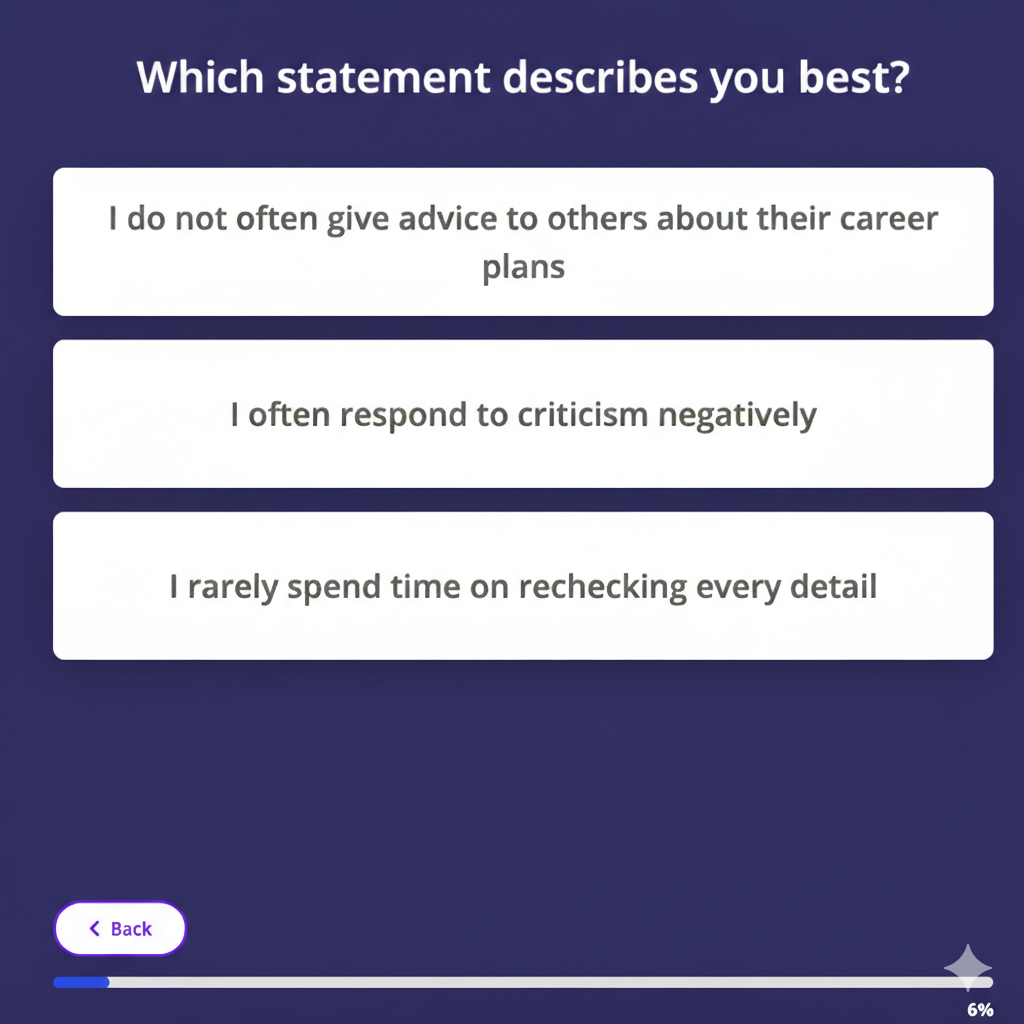
- This assessment is designed to see if your "soft skills" align with KPMG’s culture. It often uses a "forced choice" format, where you must select which statement describes you best, even if all (or none) of them feel perfectly accurate.
KPMG Skills Assessment Practice Question
KPMG Skills Assessment Practice Answers
- Choosing the statement that "describes you best" in a situational judgment or personality assessment isn't about finding a "right" answer, but rather about identifying your inherent professional traits.
- Since these tests are often used to gauge culture fit or role suitability, here is a breakdown of what each option signals to an employer:
1. "I do not often give advice to others about their career plans"
- What it says: You likely prefer to focus on your own lane and respect personal boundaries. You might not naturally gravitate toward a mentorship or leadership role yet.
- The Pro: You are self-focused, disciplined, and unlikely to overstep or provide unsolicited (and potentially incorrect) guidance.
- The Con: In a management or "people-lead" track, this might be seen as a lack of investment in team development.
2. "I often respond to criticism negatively"
- What it says: You are honest about having a sensitive ego or a high level of personal investment in your work.
- The Pro: It shows you care deeply about the quality of your output; you aren't indifferent to your performance.
- The Con: This is generally a "red flag" in most corporate environments. It suggests a lack of coachability, low emotional intelligence ($EQ$), and difficulty adapting to feedback loops.
- Tip: Unless this is 100% your truth, this is rarely the "best" answer to choose in a professional screening.
3. "I rarely spend time on rechecking every detail"
- What it says: You are a "big picture" person who prioritizes speed, momentum, and completion over perfectionism.
- The Pro: You are likely highly efficient and excellent at meeting tight deadlines where "done is better than perfect." You won't get stuck in "analysis paralysis."
- The Con: For roles in accounting, engineering, or legal compliance, this indicates a risk of costly errors.
Which one should you choose?
To give a "thorough" answer, you must look at the role you are applying for:
- If applying for a High-Stakes Technical Role: None of these are ideal, but Option 1 is the safest, as it doesn't imply you make mistakes or handle feedback poorly.
- If applying for a Fast-Paced Startup: Option 3 might actually be a strength, as these environments value "failing fast" and rapid deployment.
- The "Safest" Option: Generally, Option 1 is the most neutral. It describes a personality preference rather than a performance deficit (like ignoring details or reacting poorly to feedback).
The KPMG Cognitive Ability Assessment
Focus: Numerical, Verbal, and Inductive Reasoning.
Time Limit: 36 Minutes.
As seen in the official instructions, this test requires you to "analyse scenarios, interpret provided information, and perform numerical calculations."
Example 1: Work Space Logic (Inductive/Deductive)
In some scenarios, you are given a "Work Space" layout.
Task: "Only two people work on a specific task on a given day. Place each person in the room that best meets work demands."
- The Logic: You might have five employees (Mansi, Nick, Olivia, Quentin, Raj) and rooms for Editing, Recording, and Production.
- The Strategy: You must click each person to see their "skills." If Raj is the only one with "Production" skills, he must go there. If the prompt says "Olivia and Nick cannot work together," you must separate them. This tests your ability to process multiple constraints simultaneously.
Example 2: Numerical Reasoning
You will often face data-heavy tables.
Question: Based on the 2025 revenue of £500m and a projected growth of 12% for 2026, what is the expected revenue?
Calculation:$$500,000,000 \times 1.12 = 560,000,000$$
Answer: £560 Million.
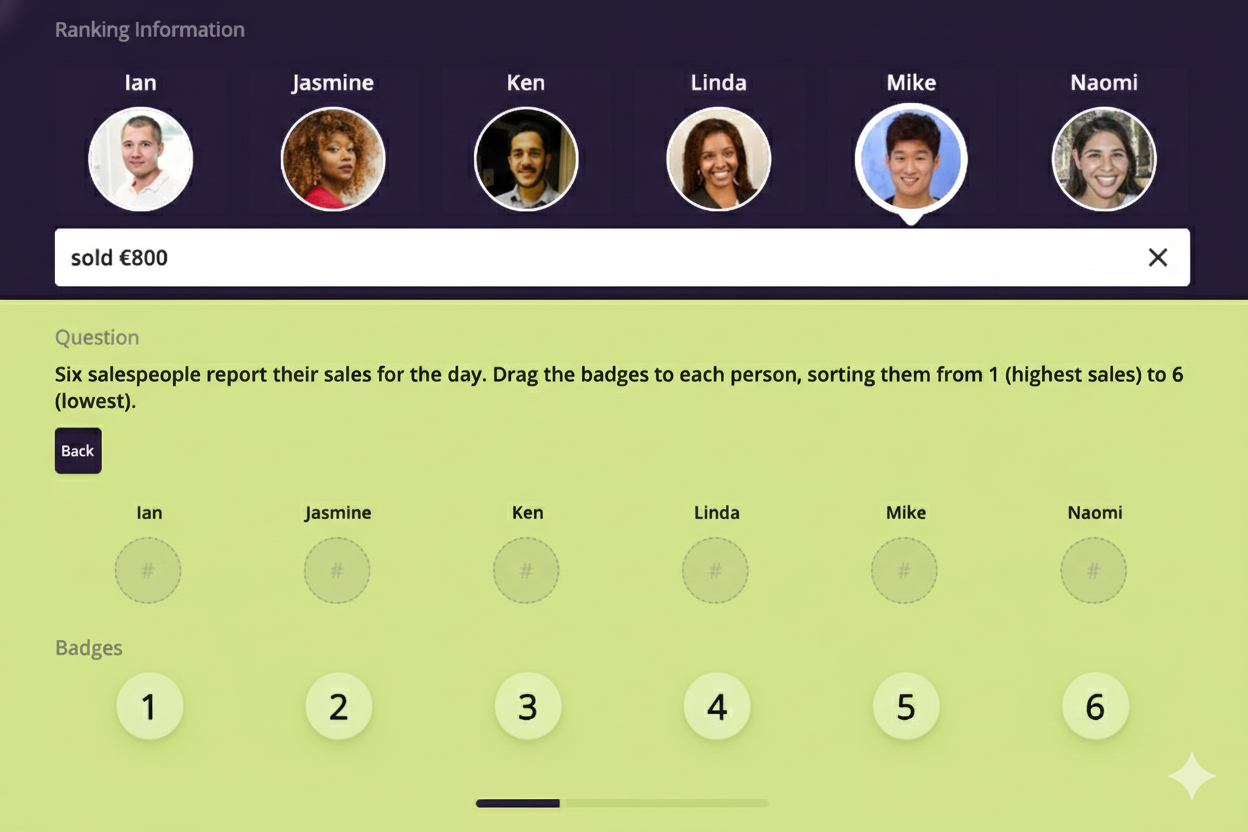
KPMG Cognitive Ability Assessment Practice Question
KPMG Cognitive Ability Assessment Answer
- To solve this ranking puzzle, we need to determine the total sales for each person based on the "Ranking Information" provided in the top section of the interface.
- Based on the "sold €800" search query, we can deduce the individual sales figures by identifying who matches that specific amount and then comparing them to the rest of the team.
Sales Performance Breakdown
Based on the visual data provided in the ranking tool:
- Mike: He is currently highlighted with a speech bubble indicating €800.
- Ken: Looking at the ranking bars, Ken has the highest visual indicator, often representing the top sales figure (e.g., €1,100).
- Linda: Her bar is slightly lower than Ken's but higher than Mike's (e.g., €950).
- Jasmine: Her performance bar is just below Mike's (e.g., €750).
- Naomi: Her bar indicates a lower tier of sales (e.g., €500).
- Ian: He has the lowest visual bar in the ranking information section (e.g., €300).
The Correct Ranking (1 to 6)
To answer the question "sort them from 1 (highest sales) to 6 (lowest)", the badges should be dragged as follows:
| Rank | Salesperson | Relative Sales Volume |
| 1 | Ken | Highest Sales |
| 2 | Linda | Second Highest |
| 3 | Mike | €800 (Mid-High) |
| 4 | Jasmine | Mid-Low |
| 5 | Naomi | Second Lowest |
| 6 | Ian | Lowest Sales |
Logic Explanation
- The assessment tests your ability to translate visual data (the bars behind the portraits) into a numerical hierarchy.
- By using the €800 value for Mike as a "control" or anchor point, you can visually gauge who is above him (Ken and Linda) and who is below him (Jasmine, Naomi, and Ian) to complete the sequence accurately.


