
BCG Quantitative Reasoning Test
Getting an invite for the BCG HireQuotient quantitative reasoning test is a major milestone in the consulting recruitment process. To help you prepare, here is a quick breakdown of the test parameters:
 Aptitudeprep
- Test Provider: HireQuotient.
- Format: 20 questions in 40 minutes.
- Conditions: Online, proctored via webcam, no navigating backward once an answer is submitted.
- Assessed Skills: Numerical reasoning, data interpretation, and mental agility under time pressure.
- Who is BCG: Boston Consulting Group (BCG) is a premier global management consulting firm.
- Purpose of Test: To evaluate a candidate's ability to process complex data and solve business-like problems efficiently.
BCG Quantitative Reasoning Test practice questions
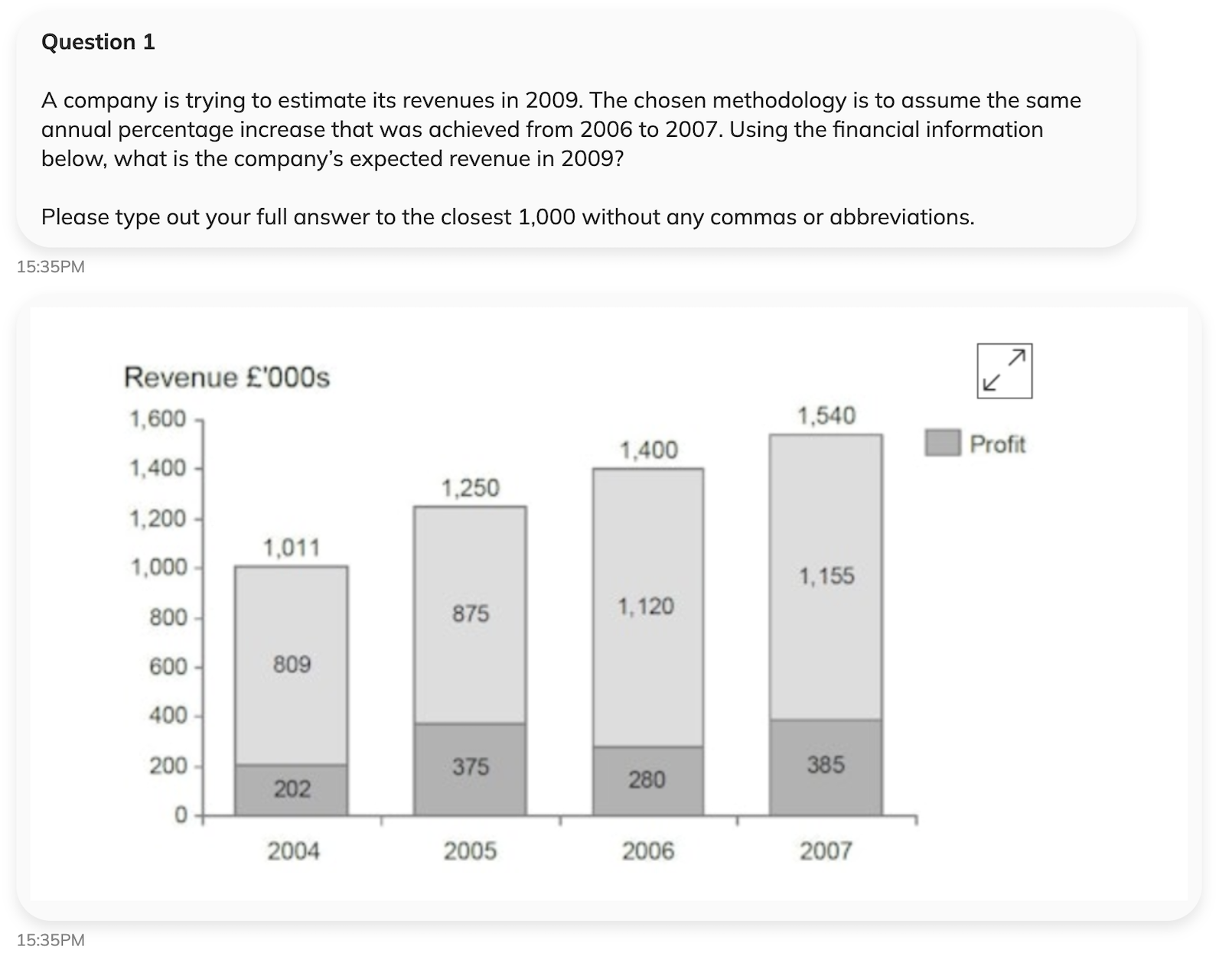
BCG Quantitative Reasoning Test practice Answer
To calculate the company’s expected revenue in 2009 based on the provided chart and methodology, follow these steps:
1. Identify the Data
From the chart, we need the total revenue for the years 2006 and 2007:
- Revenue in 2006: 1,400 (in £'000s)
- Revenue in 2007: 1,540 (in £'000s)
2. Calculate the Annual Percentage Increase (2006 to 2007)
The methodology requires us to use the same annual percentage increase achieved from 2006 to 2007.
$$Percentage\ Increase = \frac{Final\ Value - Starting\ Value}{Starting\ Value} \times 100$$$$Percentage\ Increase = \frac{1,540 - 1,400}{1,400} = \frac{140}{1,400} = 0.10\ or\ 10\%$$
3. Project Revenue for 2008
Assuming the same 10% annual growth continues:
- Revenue in 2008 = Revenue in 2007 $\times$ (1 + 0.10)
- Revenue in 2008 = 1,540 $\times$ 1.10 = 1,694 (in £'000s)
4. Project Revenue for 2009
Apply the 10% growth rate again to the 2008 figure:
- Revenue in 2009 = Revenue in 2008 $\times$ (1 + 0.10)
- Revenue in 2009 = 1,694 $\times$ 1.10 = 1,863.4 (in £'000s)
5. Final Formatting
The question asks for the answer in £'000s, rounded to the closest 1,000 without commas or abbreviations.
- Calculated Value: 1,863.4 (thousands)
- Rounded to the closest 1,000: 1,863
Final Answer:
1863000
(Note: The "closest 1,000" refers to the actual numerical value. Since the chart is in £'000s, 1,863.4 represents £1,863,400. Rounding this to the closest 1,000 gives £1,863,000. If the system expects the number as represented on the Y-axis units, the answer would be 1863.)
Summary of Steps
- Growth Rate: $1,540 / 1,400 = 1.1$ (10% increase).
- Two-Year Projection: $1,540 \times (1.1)^2 = 1,863.4$.
- Result: £1,863,400.
- Rounded: 1863000.
bcg quantitative reasoning test reddit
Understanding the Question Flow
A critical missing piece in many preparation guides is the actual flow of the questions. Unlike a traditional exam where you see all problems at once, the BCG HireQuotient quantitative reasoning test follows a structured, sequential narrative:
- Sequential Narrative: The test is often divided into sections based on a single, evolving business scenario.
- Document Progression: You typically start with a context block (a case briefing with 1–2 initial documents). As you answer correctly and move forward, new exhibits, charts, or tables are "unlocked" to add layers to the case.
- Point-of-No-Return: Because of the "no-backwards" rule, the flow is strictly one-way. You must be 100% confident in your current answer before proceeding, as follow-up questions often rely on the results of your previous calculations.
- No Fixed Time Per Question: While the test is 40 minutes for 20 questions, there is no 2-minute hard limit per individual question. You manage your own 40-minute "pot" of time. Some data-heavy questions may take 4 minutes, while simple fact-checks might take 30 seconds.
Navigating the Assessment
- The BCG quantitative reasoning test questions are designed to be challenging. Unlike standard math exams, these questions require you to interpret charts, handle currency conversions, and solve multi-step word problems within a strict average timing pressure.
- If you search for BCG quantitative reasoning assessment Reddit threads, you’ll find that the most successful candidates emphasise two things: accuracy and speed. Because you cannot return to a question once submitted, your first attempt at a calculation must be precise.
Study with Sample Problems
To get a feel for the difficulty, let’s look at some BCG quantitative reasoning assessment sample questions based on the 2026 assessment:
- Currency Logic: Converting GBP to USD on a Monday, then back to GBP on a Saturday after a percentage of the money has been spent.
- Growth Metrics: Calculating the Compound Annual Growth Rate (CAGR) of a company’s sales over a three-year period.
- Spatial Reasoning: Determining the shortest distance between a starting point and a destination after multiple directional changes (South, West, East, North).
How to Prepare Effectively
Relying solely on finding BCG quantitative reasoning assessment answers online won't help during the live, proctored exam. Instead, focus on a robust BCG numerical test practice routine:
- Master the CAGR Formula: You will almost certainly face a question regarding year-on-year growth.
- Practice Chart Reading: Questions often involve "hidden" data, such as calculating the number of "very satisfied" customers by multiplying a percentage against a total respondent pool.
- Use a Practice Test: Taking a BCG quantitative reasoning assessment practice test under timed conditions is the only way to get used to the "no-backwards" navigation rule.
Final Tips for Success
- When you begin your BCG quantitative reasoning assessment questions, ensure you are in a quiet environment with a steady internet connection, as lost time cannot be recovered.
- Treat the BCG HireQuotient quantitative reasoning test as your first "case"—be methodical, stay calm, and keep a close eye on the clock.


